Wings made of scales, feet that taste
A butterfly or moth is covered in tiny scales, smells with its antennae, tastes with its feet and, in some cases, can hear a bat coming.
Scaly wings
Lepidoptera comes from Greek and means ‘scaly wings’. Natural History Museum, London: UK moths, nine of the most colourful and distinctive The name refers to the tiny, dust-like scales that cover the wings. Britannica: Lepidoptera
The ‘powder’ that rubs off a butterfly’s wing is actually its scales, so look but don’t touch. American Museum of Natural History: Butterfly FAQ Each wing scale is a single colour. Most colours come from pigments, but shimmering colours come from tiny structures on the scale’s surface. American Museum of Natural History: Butterfly FAQ
Smell, taste and sight
Smell is by far a butterfly’s most important sense, picked up by sensors on its antennae. American Museum of Natural History: Butterfly FAQ Butterflies have ‘taste buds’ at the end of the tongue, and females taste plants with their feet to check them before laying eggs. American Museum of Natural History: Butterfly FAQ
Butterflies can see ultraviolet light, which is invisible to us. American Museum of Natural History: Butterfly FAQ
Sound
A few butterflies use sound: the male cracker butterfly makes loud noises with its wings. American Museum of Natural History: Butterfly FAQ Some moths can hear bats’ hunting calls, and swerve or dive to the ground to escape. Britannica: Lepidoptera (natural history, behaviour and ecology)
The greater wax moth can hear sounds close to 300,000 hertz, higher than any bat call known. Britannica: Lepidoptera (natural history, behaviour and ecology) Tiger moths that taste bad make high-pitched clicks that people can’t hear but bats can, which may warn bats off. Britannica: Lepidoptera (natural history, behaviour and ecology)
Food
Most adults feed on nectar, but sap, rotting fruit, honeydew from aphids, dung and carrion are sometimes used. Britannica: Lepidoptera (natural history, behaviour and ecology) In a few groups the adult mouthparts don’t work at all, so the adults never eat. All their food is eaten as caterpillars. Britannica: Lepidoptera (natural history, behaviour and ecology)
Some orchids with very deep flowers seem to be pollinated only by hawk-moths with very long tongues (proboscises). Britannica: Lepidoptera (natural history, behaviour and ecology) Darwin saw an orchid with a very long nectar tube and predicted a moth with a tongue long enough to reach it. The moth was found decades after his death. Royal Botanic Gardens, Kew: Darwin’s orchid
Size
The smallest moths have wingspans of about 4 mm. The biggest moths and butterflies measure nearly 30 cm. Britannica: Lepidoptera One of the smallest butterflies, the eastern pygmy blue of the south-eastern United States, has a wingspan of about 5/8 of an inch (about 1.6 cm). American Museum of Natural History: Butterfly FAQ
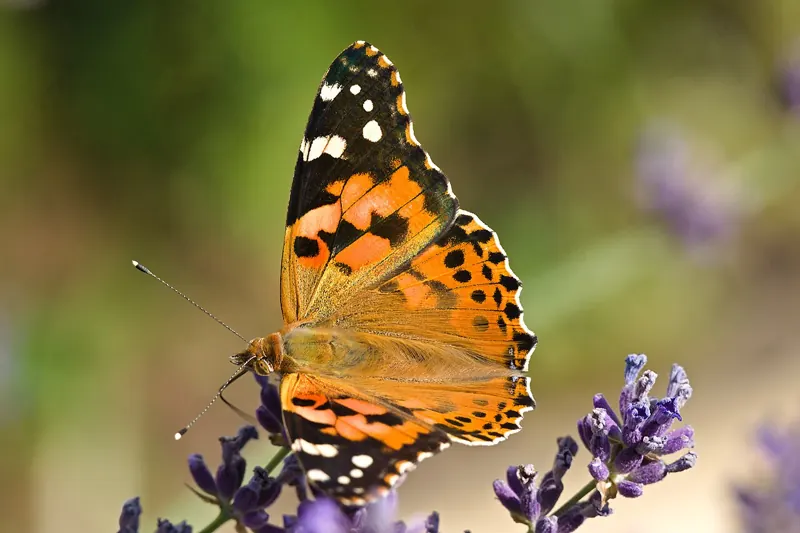
A Painted Lady weighs less than a gram and has a brain the size of a pin head. University of York: Painted Lady migration secrets unveiled
Rest and lifespan
Butterflies don’t sleep as we do, but many rest together in groups. This is called roosting. American Museum of Natural History: Butterfly FAQ Most adult butterflies live only a few weeks. Migratory species may live up to 10 months. American Museum of Natural History: Butterfly FAQ
Next: egg to wing →