One big family, two rough labels
Butterflies are a small, colourful branch of the moth family tree. Here’s how to tell them apart, most of the time.
Not so different
There is no real scientific difference between butterflies and moths; we split them out of habit. Oxford University Museum of Natural History: Lepidoptera The Australian Museum describes butterflies and skippers as groups of specialised moths. Australian Museum: What are the differences between butterflies and moths?
Worldwide there are five families of butterflies and one of skippers, but 125 families of moths. Australian Museum: What are the differences between butterflies and moths?
The rules of thumb
Rule of thumb: butterflies fly by day, rest with wings held together above the back and have clubbed antennae; moths mostly fly at night, rest with wings flat and have straight or feathery antennae. American Museum of Natural History: Butterfly FAQ
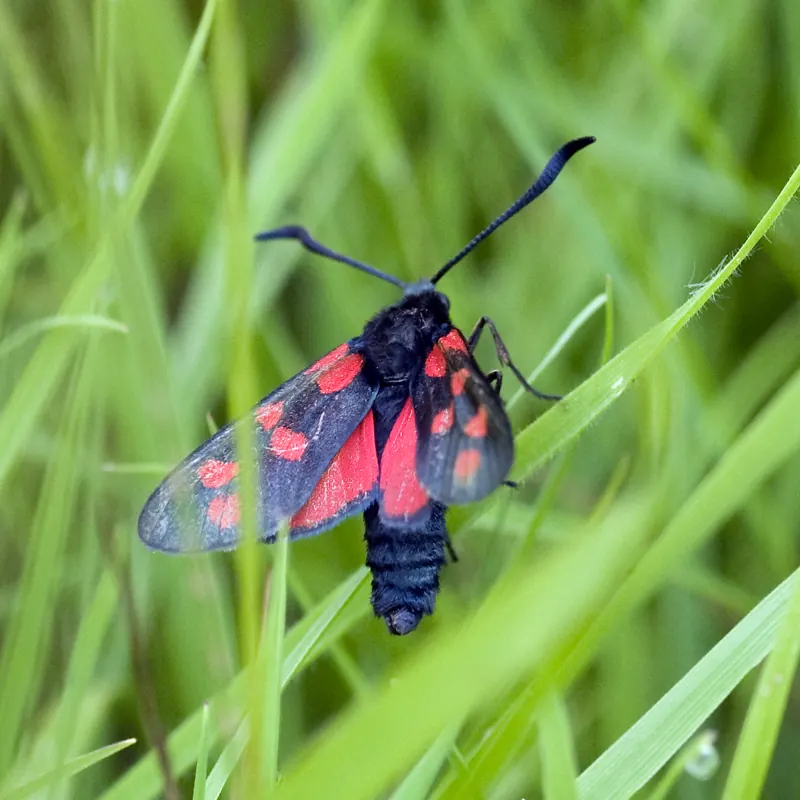
…and the exceptions
Not all moths fly at night: the Cinnabar and Scarlet Tiger fly by day, and some butterflies, such as the Red Admiral, fly at night. Butterfly Conservation: Moth myths Some moths have clubbed antennae too, such as the day-flying burnets. Butterfly Conservation: Moth myths
Moths are not all dull. Tiger moths are almost gaudy, and many dull moths have intricate camouflage patterns. Butterfly Conservation: Moth myths Brightly coloured moths are often day-flyers, or species warning predators that they taste bad. Dull colours hide night-flying moths while they rest by day. Natural History Museum, London: UK moths, nine of the most colourful and distinctive
The most consistent difference
The most consistent difference: nearly all moths have a tiny hook joining the hindwing to the forewing. Butterflies do not. Butterfly Conservation: Moth myths That wing-locking bristle is called a frenulum. Australian Museum: What are the differences between butterflies and moths?
Feathery antennae
The ‘feathery’ antennae of many male moths pick up tiny amounts of scent (pheromones) released by females. Australian Museum: What are the differences between butterflies and moths? Males of giant silkworm moths, with very large feathery antennae, can find females 5 to 6 km (3 to 4 miles) away. Britannica: Lepidoptera (natural history, behaviour and ecology)
Cocoons and chrysalises
Many moth caterpillars spin silk cocoons to pupate in. Many butterfly pupae are not hidden in cocoons at all. Australian Museum: What are the differences between butterflies and moths? Most butterflies don’t spin cocoons: their own body forms the chrysalis. Many hang head-down from a silk pad. Britannica: Lepidoptera (natural history, behaviour and ecology)
Do moths eat clothes?
Of about 2,500 moth species in Britain, only a very few eat clothes, and only fabrics from animals such as wool. Butterfly Conservation: Moth myths More than 90% of moth caterpillars eat plants: leaves, roots, seeds and fruits. Natural History Museum, London: UK moths, nine of the most colourful and distinctive
- Britain has over 2,500 species of moth. Since 1900, 51 have died out here. Butterfly Conservation: Moths · checked 30 Oct 2026
- The Oxford University Museum of Natural History puts the world total at 165,000 species, with 2,495 in the UK. Oxford University Museum of Natural History: Lepidoptera · checked 30 Oct 2026
Butterfly Conservation says over 2,500 moths. The Oxford museum’s UK figure of 2,495 is for butterflies and moths together. The sources don’t explain the gap. Every disagreement we found →
Can you tell them apart? Try the Butterfly or Moth? game.
Next: scales & senses →