Monarchs, Painted Ladies and the winds
Some butterflies travel further than many birds, using fast winds high above our heads.
The Monarch
North America’s monarch makes a two-way migration, like a bird: south in autumn and back north in spring. US Forest Service: Monarch butterfly migration and overwintering The monarchs that fly south have never been to Mexico before, yet they find the way. US Forest Service: Monarch butterfly migration and overwintering
Monarchs travel 50 to 100 miles a day. The farthest a monarch has been recorded flying in one day is 265 miles. US Forest Service: Monarch butterfly migration and overwintering The trip north takes several generations: the great-grandchildren of the monarchs that wintered in Mexico make the return journey. US National Park Service: Milkweed and monarchs
- The US Forest Service says some monarchs fly as far as 3,000 miles to reach their winter home. US Forest Service: Monarch butterfly migration and overwintering
- Butterfly Conservation says millions of monarchs make a 2,000-mile (3,220 km) journey each year from Canada to central Mexico. Butterfly Conservation: Monarch
One figure is the usual journey from Canada to Mexico; the other is the farthest some monarchs fly. Both come from trusted sources, so we show both. Every disagreement we found →
Winter in the mountains
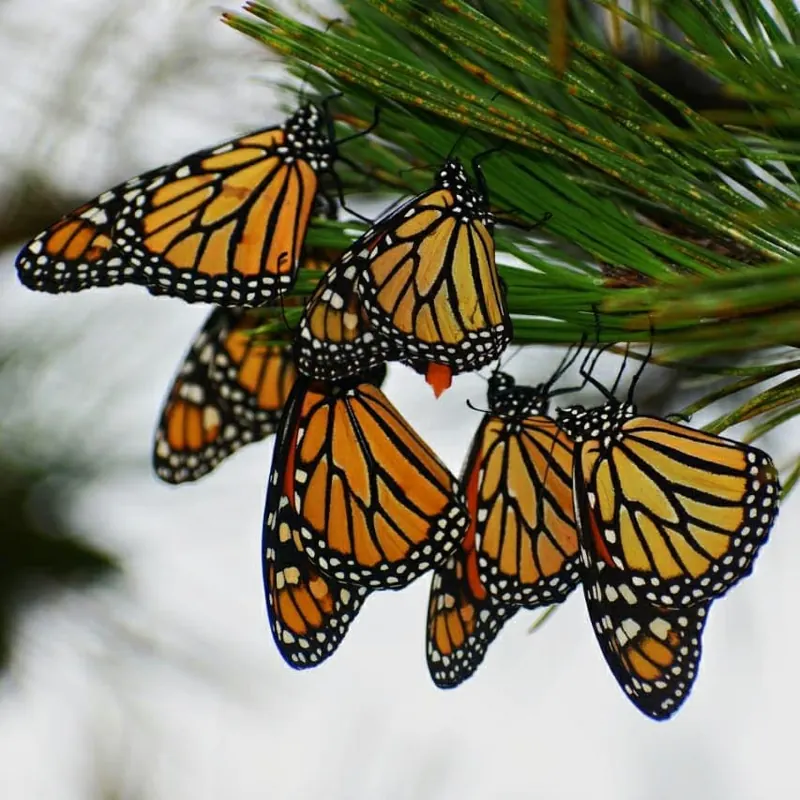
Eastern monarchs spend the winter in oyamel fir forests in the mountains of Mexico, 2,400 to 3,600 metres up. US Forest Service: Monarch butterfly migration and overwintering Tens of thousands of monarchs can cluster on a single tree to keep warm, though each weighs less than a gram. US Forest Service: Monarch butterfly migration and overwintering
Milkweed
Monarchs lay eggs only on milkweed, and their caterpillars eat only milkweed leaves. US National Park Service: Milkweed and monarchs Milkweed sap contains chemicals poisonous to most animals. Monarchs resist it, and it protects their caterpillars from predators. US National Park Service: Milkweed and monarchs
The Monarch is the largest butterfly seen in the British Isles, but it is a very rare visitor, first recorded here in 1876. Butterfly Conservation: Monarch Monarchs have never been recorded breeding in Britain, because their milkweed food plants are not native here. Butterfly Conservation: Monarch
The Painted Lady
Each year the Painted Lady spreads north from the desert fringes of North Africa, the Middle East and central Asia, reaching Britain and Ireland. Butterfly Conservation: Painted Lady Painted Ladies make a 9,000-mile round trip between tropical Africa and the Arctic Circle, in steps by up to six generations. University of York: Painted Lady migration secrets unveiled
Radar showed Painted Ladies fly south at an average height of over 500 metres, reaching 30 mph on good winds, out of sight of people on the ground. University of York: Painted Lady migration secrets unveiled In 2009 about 11 million Painted Ladies flew into the UK in spring, and 26 million left in autumn. University of York: Painted Lady migration secrets unveiled
The discovery used more than 60,000 sightings sent in by the public across Europe in 2009, including 10,000 British observers. University of York: Painted Lady migration secrets unveiled A Painted Lady weighs less than a gram and has a brain the size of a pin head. University of York: Painted Lady migration secrets unveiled
- Britannica describes Painted Lady mass flights as one-way emigrations rather than true migrations. Britannica: Lepidoptera (natural history, behaviour and ecology)
- Painted Ladies make a 9,000-mile round trip between tropical Africa and the Arctic Circle, in steps by up to six generations. University of York: Painted Lady migration secrets unveiled
- Radar showed Painted Ladies fly south at an average height of over 500 metres, reaching 30 mph on good winds, out of sight of people on the ground. University of York: Painted Lady migration secrets unveiled
Britannica’s article describes one-way emigrations. The 2009 radar study led by the University of York found Painted Ladies flying back south in autumn, high up and out of sight of people on the ground. Every disagreement we found →
Riding the wind
Radar studies show migrating butterflies and moths pick fast winds a few hundred metres up, travelling at up to 100 km (62 miles) an hour. Britannica: Lepidoptera (natural history, behaviour and ecology) Red Admirals can turn up anywhere, from town centres to the tops of mountains. They migrate north each spring from North Africa and continental Europe. Butterfly Conservation: Red Admiral
Red Admirals now regularly spend the winter in the UK, thanks to milder conditions. Manx Wildlife Trust: Butterfly count · checked 30 Oct 2026
Next: the species →