Fossils, painters and Darwin’s moths
Moths were flying before flowers bloomed, and people have been watching, painting and puzzling over them for centuries.
Older than flowers
The oldest known fossils of butterflies and moths are tiny wing and body scales from rocks laid down around a mass extinction 201 million years ago, found in a rock core drilled in northern Germany. They are more than 70 million years older than the oldest fossils of flowering plants. Utrecht University: World’s oldest moths also roamed Jurassic Park Some of those early moths already had sucking mouthparts, probably used to sip sugary droplets from plants without flowers. Utrecht University: World’s oldest moths also roamed Jurassic Park
Maria Sibylla Merian
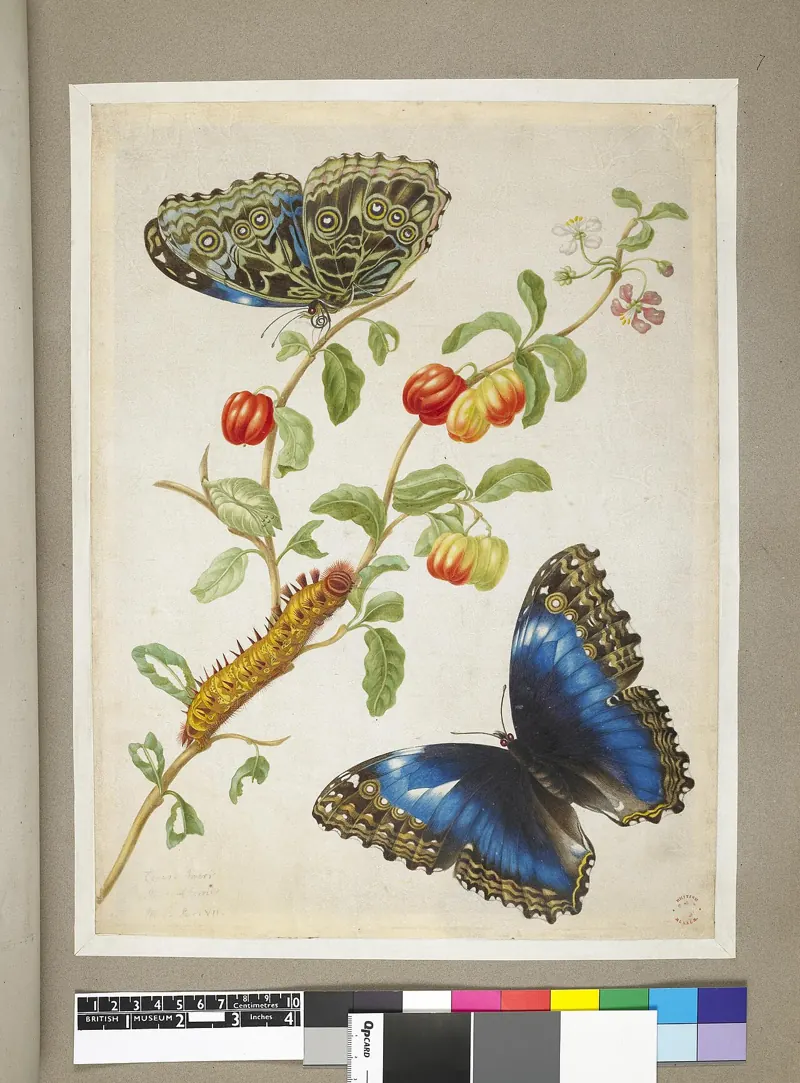
Maria Sibylla Merian was born in Frankfurt on 2 April 1647. By 13 she was rearing silkworms and recording their life cycle. Natural History Museum, London: Maria Sibylla Merian In her day, many people believed insects sprang from mud and rubbish (‘spontaneous generation’). Merian was one of the first to watch and record metamorphosis closely. Natural History Museum, London: Maria Sibylla Merian
Her first ‘caterpillar book’ (1679) had 50 copper-plate engravings showing insect life cycles with their food plants. Natural History Museum, London: Maria Sibylla Merian Sometimes flies or wasps hatched instead of a butterfly. She called these ‘false changes’, perhaps the earliest scientific record of insect parasites. Natural History Museum, London: Maria Sibylla Merian
In 1699, aged 52, she sailed with her daughter Dorothea to Suriname on the first-ever purely scientific expedition. Natural History Museum, London: Maria Sibylla Merian
Darwin’s predictions
Darwin saw an orchid with a very long nectar tube and predicted a moth with a tongue long enough to reach it. The moth was found decades after his death. Royal Botanic Gardens, Kew: Darwin’s orchid The orchid’s nectar spur can be up to 45 cm long. Royal Botanic Gardens, Kew: Darwin’s orchid
Darwin’s moth
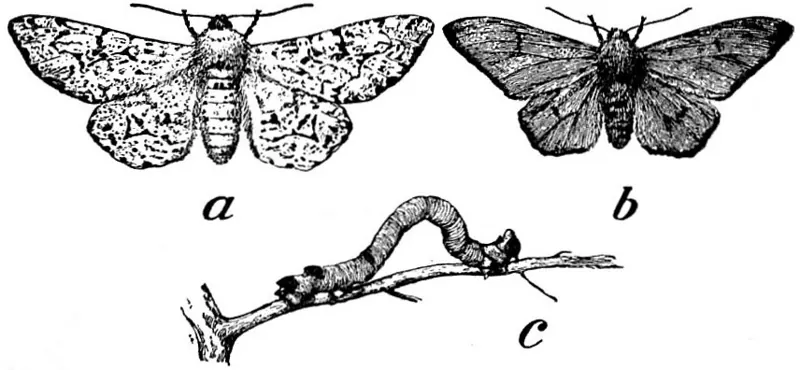
The Peppered Moth is famous as ‘Darwin’s moth’, one of the best-known examples of evolution by natural selection. Butterfly Conservation: Peppered Moth The first black Peppered Moth was recorded in Manchester in 1848. By 1895, 98% of the city’s Peppered Moths were black, because soot had blackened the trees and black moths were better hidden from predators. Butterfly Conservation: Peppered Moth and natural selection
When air pollution was controlled in the twentieth century and lichens grew back on trees, the pale form became common again. Butterfly Conservation: Peppered Moth and natural selection Peppered Moth numbers in Britain fell by almost two thirds between 1968 and 2002, for reasons not yet known. Butterfly Conservation: Peppered Moth and natural selection
Silk
Nearly all silk comes from the domesticated silkworm, a moth caterpillar originally from China. Britannica: Lepidoptera The silkworm moth has been domesticated so completely that it is no longer found in the wild. The adults cannot fly and do not eat. Britannica: Silkworm moth
A silkworm cocoon is one continuous strand of silk averaging about 915 metres (1,000 yards) long. Britannica: Silkworm moth
The word
The word ‘butterfly’ was in use before the 12th century. Merriam-Webster: butterfly One theory is that the word ‘butterfly’ comes from the yellow colour of male Brimstones. Butterfly Conservation: Brimstone
Lepidoptera comes from Greek and means ‘scaly wings’. Natural History Museum, London: UK moths, nine of the most colourful and distinctive
In art
Butterflies have inspired art for thousands of years and appear in paintings, jewellery, textiles, coats of arms and postage stamps. Britannica: Lepidoptera
Counting butterflies
In the 2009 Painted Lady study, about 10,000 British members of the public helped solve where the butterflies go in autumn. University of York: Painted Lady migration secrets unveiled More than 15,000 volunteers record and count butterflies for Butterfly Conservation’s schemes. Butterfly Conservation: Butterflies · checked 30 Oct 2026
Unlike some other insect groups, butterflies and moths do not spread plant diseases, and none of them are parasites of people. Britannica: Lepidoptera Many adults are important pollinators, because they visit flowers for nectar. Britannica: Lepidoptera
Caterpillars turn huge amounts of plant matter into animal matter, and are food for many other animals. Britannica: Lepidoptera